 Our pal, designer Jamie Gibbs, updates the chaise longue, or fainting couch.
 Our pal, designer Jamie Gibbs, updates the chaise longue, or fainting couch.
With the popularity of floating furniture arrangements, the chaise longue has seen an increased interest. Basically an upholstered couch in the shape of a chair long enough to support the legs, these are often called “chaise lounges” in North America, particularly in the furniture industry.

This mixed spelling and transliteration of longue, French for long, has become well-established and even found in American dictionaries (it’s an example of folk etymology, which Wikipedia defines as “a commonly held misunderstanding of the origin of a particular word.”) The term also refers to any long chair, even a folding deckchair. A duchesse brisée is similar, but looks like a chair together with a long footstool.
 Here’s where it gets technical: a chaise longue with a backrest at both ends also is known as a récamier, named after the famed, 1800 Jacques-Louis David portrait of Madame Juliette Récamier in the Louvre. During the early 19th century it was quite fashionable for ladies to have salons, informal gatherings akin to cocktail parties, where society and politics converged. Great beauties also posed for prominent painters, such as David, in special settings like this one with furniture in the new Greek style of the time.
The Victorians were great revivalists and the récamier gained wild popularity then. Why? For two reasons. Ladies wore hoop skirts and a divan allowed them to sit comfortably without the arms of a chair restricting them. And, of course there were those corsets. We also have come to know this piece of furniture as a “fainting couch” because Victorian women were so corseted they could lie down easily when they felt faint from lack of oxygen!
 Now, my dream piece, the 1810, French Directoire mahogany chaise longue I saw in Holland. While I wanted it to fit in my imaginary steamer trunk, I also realized that it was a six-figure piece (from Pelham, in Paris). But it would be so perfect at the foot on my bed or by the large bay window in my bedroom. As many of us do, I also have a dead end in my dining room where I could create a small sitting area, just ideal for serving tea or drinks to friends. Since this is really the best example of a chaise I have ever seen outside a museum, I wouldn’t do anything to it to reduce its value like refinishing or upholstery in a fun fabric (the silk upholstery is serious and new). Leave that to the less valuable models.
Only ten years ago, Brooklyn antiques dealers were giving away Victorian chaises for well under $1,000 and some would even upholster them with your own fabric to make the sale. So I thought it would be a good idea to find some less expensive examples. Now don’t faint – I’ve mixed up the styles, too.
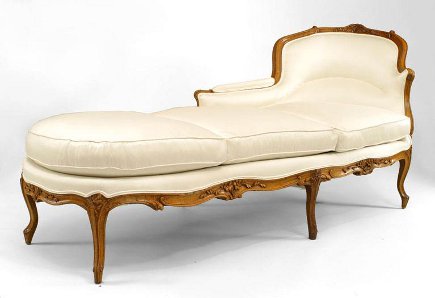 This is a French 18th century Louis XV beechwood chaise from Newel, which would retain its high (five figure) resale value. I wouldn’t touch the carved wood, but new upholstery to compliment the decor wouldn’t hurt its value. This style has been widely reproduced, especially during the 1950’s and 60’s. The repros are all over the place today and given the new-found love of mid-century furniture, price tags are often in the very favorable $300 range. Since it will be many years before any 20th century reproduction would pull down a hefty price tag this surely is a place to get creative. Paint the frame a fun color. Upholster something WILD! When you treat one of these like art, it doesn’t really matter what your decorating style is supposed to be. You want the chaise to stand out.
Victorian chaises (by that era for fainting) are usually larger and more cumbersome than the 18th century versions. Because of their size they can have a few limitations for use today. Also, many were factory made with veneered woods and awkward carvings so there can be bargains on those. They are still the perfect hall bench or focal point for a sitting area and I would also use one as an art or accent piece. You can sleep well at night knowing you got a funky-style chaise for very little (and dolled it up with unusual fabrics and even silly trims and throw pillows).
 Of course, really great late Empire and early Victorian pieces — like this ca. 1820 Swedish mahogany beauty from Grant antiques — deserve respect.
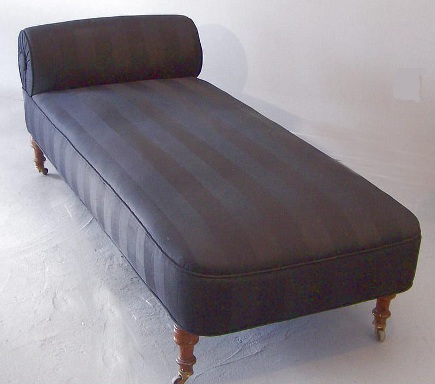 Here is a really great example of the clean, simple lines that began to emerge at the end of the 19th century. American, ca. 1880, this chaise from One of a Kind Antiques and Arts has a rolled head support and mahogany legs. Check out George Smith, the high end English furniture manufacturer, to see really excellent reproduction furniture in similar styles. Sized to fit today’s homes, these pieces work well as backless couches or as places to curl up in private moments. They can transcend styles from traditional to contemporary, depending on the upholstery fabric.
 This tufted piece, upholstered in red chenille from Brookleberrys Antiques looks like it would be extremely uncomfortable, but it’s so great to look at! It will be difficult to place and really needs to stand alone, but it could merit a place of honor in many rooms. It is also affordable enough to upholster in a trendy fabric for specialty use — say in the master bedroom or a sun room, where you retreat to read. I’d add lots of small throw pillows and kidney rolls.
If you have a problem with historical styles or a chase with traditional roots of a chaise, then the contemporary Klaussner Solway chaise [top] from chaiselounges.com might be a solution. This is definitely not your grandmother’s furniture, but it is far more chic than a recliner for watching TV and there’s no need to leave space behind it since it doesn’t move. A well designed chaise should be easy to get into and out of. I would definitely use contemporary styles for living rooms and bedrooms.
Jamie has also written about Fabric Schemes and explained how to Boost Your Fabric IQ.
(Sources: Newel Antiques, Grant Antiques, One of a Kind Antiques, Pelham Antiques, chaiselounges.com)
Copy and Paste the Link to Quick Share this Post: http://bit.ly/I9Cas0
I love chaise lounges, but for some reason the contemporary version (first picture) looks pedestrian to me. When you compare it to a recliner though, that definitely gives a new perspective.
Funny mb. I rather like the modern one and it’s by far the most affordable. But I just like chaises I guess.
Victorian fainting couches are so beautiful, but yes, that modern one looks so much more comfortable!